Agora — Project log & lessons learned
This document is the round-by-round project log: architecture, the five load-bearing ideas, what failed and why, and the round table of fixes that drove each gate from a real run.
Layered snapshots: the bulk of this file is the original
2026-04-17 snapshot covering Runs 1–17 on qwen2.5:7b-instruct (a
three-day active testing window per the workspace git history, despite
“stress-test week” framing in the prose). The Post-2026-04-17 work
section near the bottom captures the nine days that followed
(2026-04-18 to 2026-04-26): multi-provider adapter via LiteLLM, the
plan-builder meta-flow, and structural-validation hardening (Rounds
14–18).
Run history archive: structured per-run records and cross-cutting
analysis live under runs/ — registry.yaml is the single
source of truth, findings.md synthesises themes, README.md indexes
the lot.
Date: 2026-04-17 (end of stress-test week, Runs 1–16)
Model under test: qwen2.5:7b-instruct (Q4_K_M, local Ollama, RTX 3060 Ti 8 GB)
Test coverage: 501 tests passing, 82.17% coverage
Status: Framework stable. Delivered working artifacts in two distinct domains
(Discord bot, FastAPI CRUD) via a weak local LLM.
What Agora is
A multi-agent orchestration framework that takes a weak local LLM and a DAG of specified tasks, and drives the LLM to produce working code end-to-end. The pattern: make the framework absorb everything the model is unreliable at, so the model only does what it’s good at (generating small focused payloads).
The architecture is built around the Manifold Specification Pattern — every task carries preconditions and postconditions, and the framework enforces them as deterministic gates. Matrix is the event bus + human-observer surface; Git is the artifact store; Ollama serves the models.
Architecture at a glance
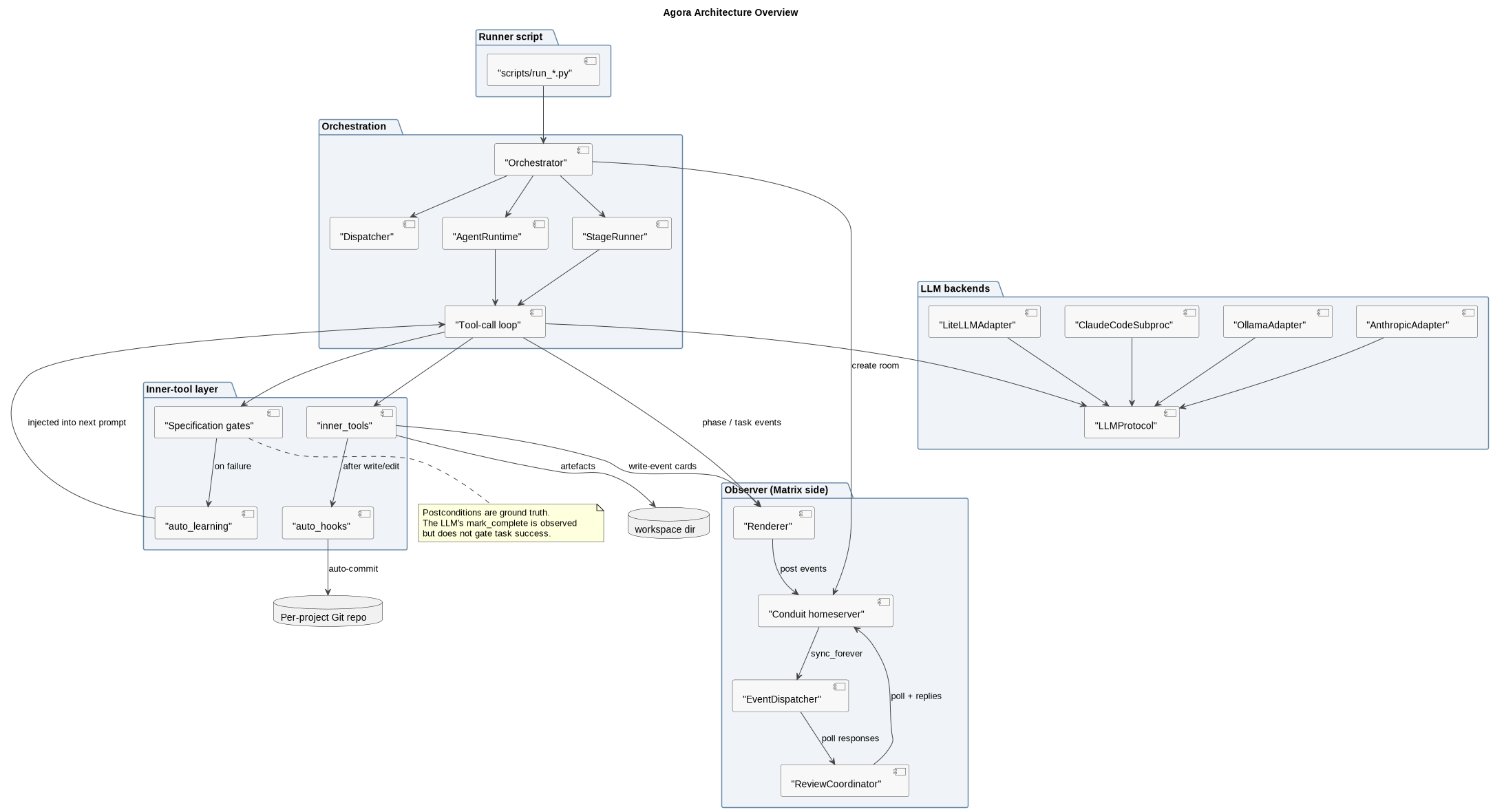
The runner builds the task DAG, the orchestrator drives execution through the phase state machine, the agent runtime / stage runner share a tool-call loop that calls inner tools and the LLM, postcondition gates determine success, auto-learnings feed the next attempt, and the observer surface streams everything into Matrix. Source: diagrams/architecture.puml.
50 Python modules under src/agora/, 62 test modules under tests/. Core
packages:
core/— domain types (Task, Specification, Predicate, Project, Learning). Pure, no I/O. Postconditions live here.fleet/— the orchestration engine. Everything the LLM touches flows through this layer.matrix/— matrix-nio wrapper + SSRF-safe HTTPS fetcher.observe/— Element-side UX: formatters, polls, renderer, review, command parser.
State machines
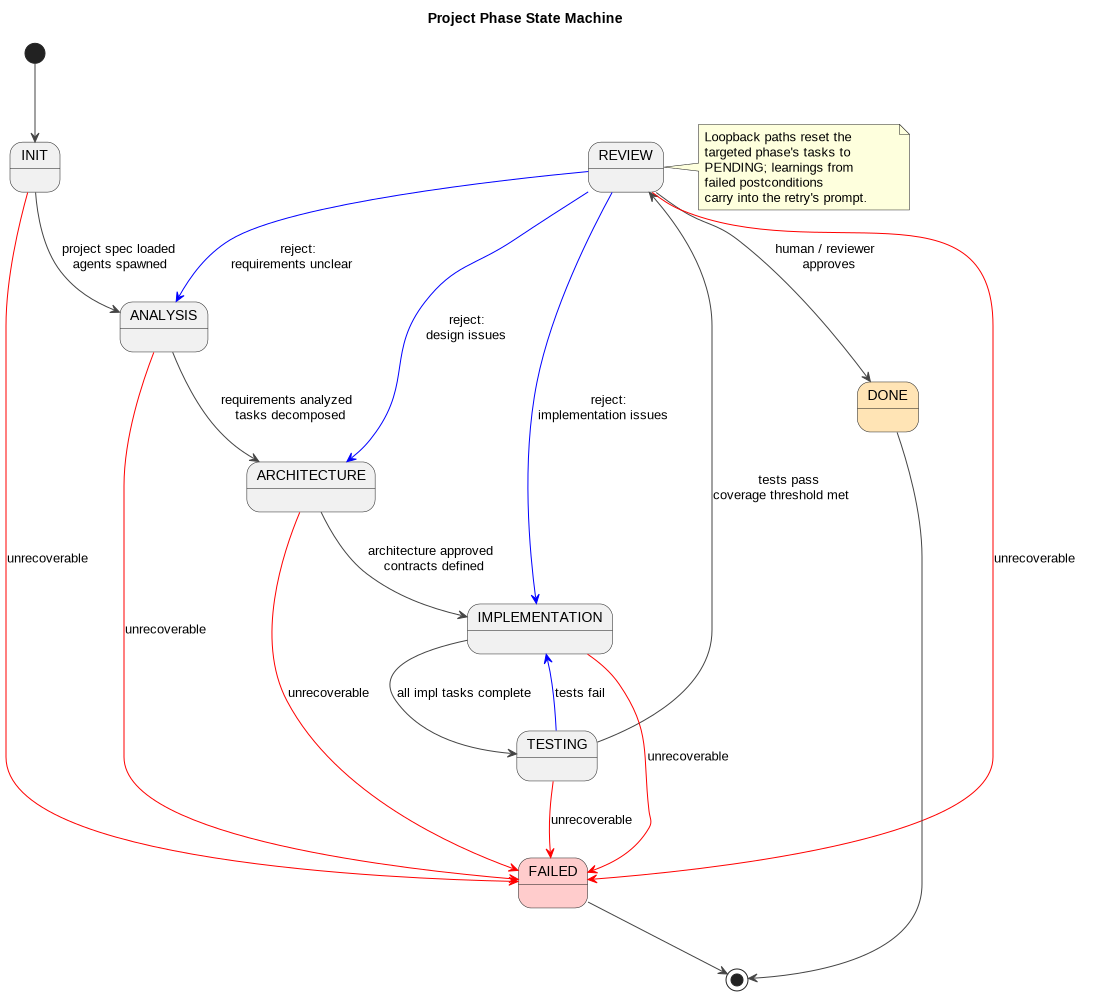
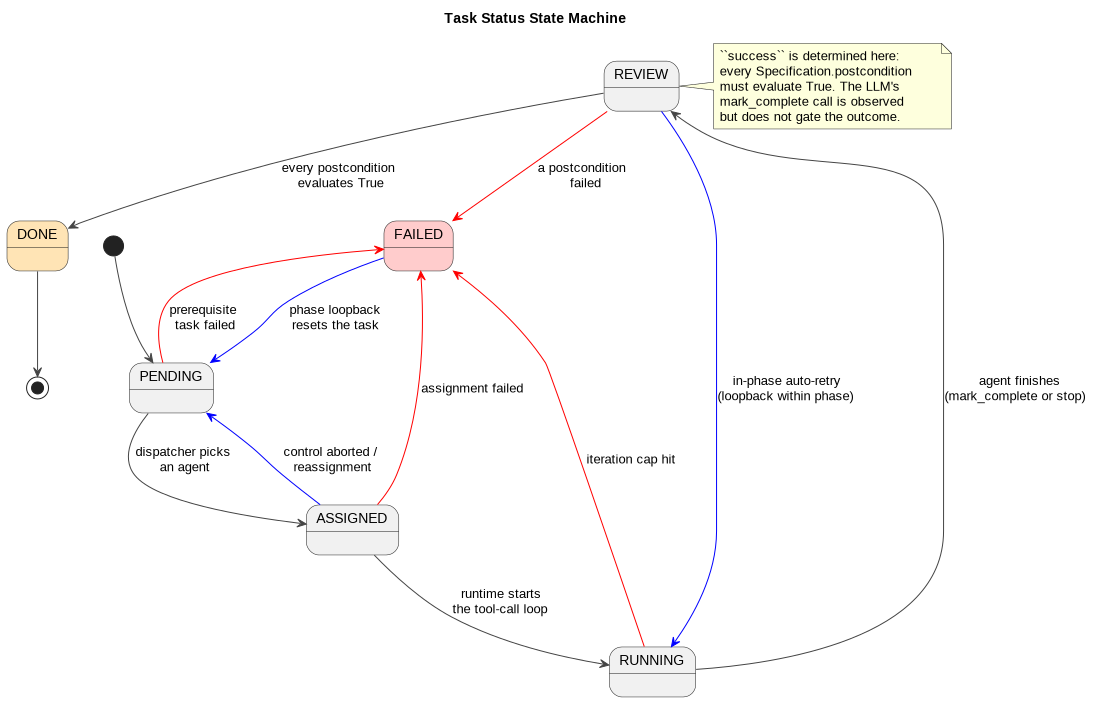
Two state machines gate execution. Mirrored from
agora/core/project.py and
agora/core/task.py respectively;
loop-back paths in blue, unrecoverable-failure paths in red.
Project phases |
Task status |
|---|---|
|
|
The five load-bearing ideas
The flow below is what each task actually goes through — every load-bearing idea named in this section corresponds to a step in the sequence.
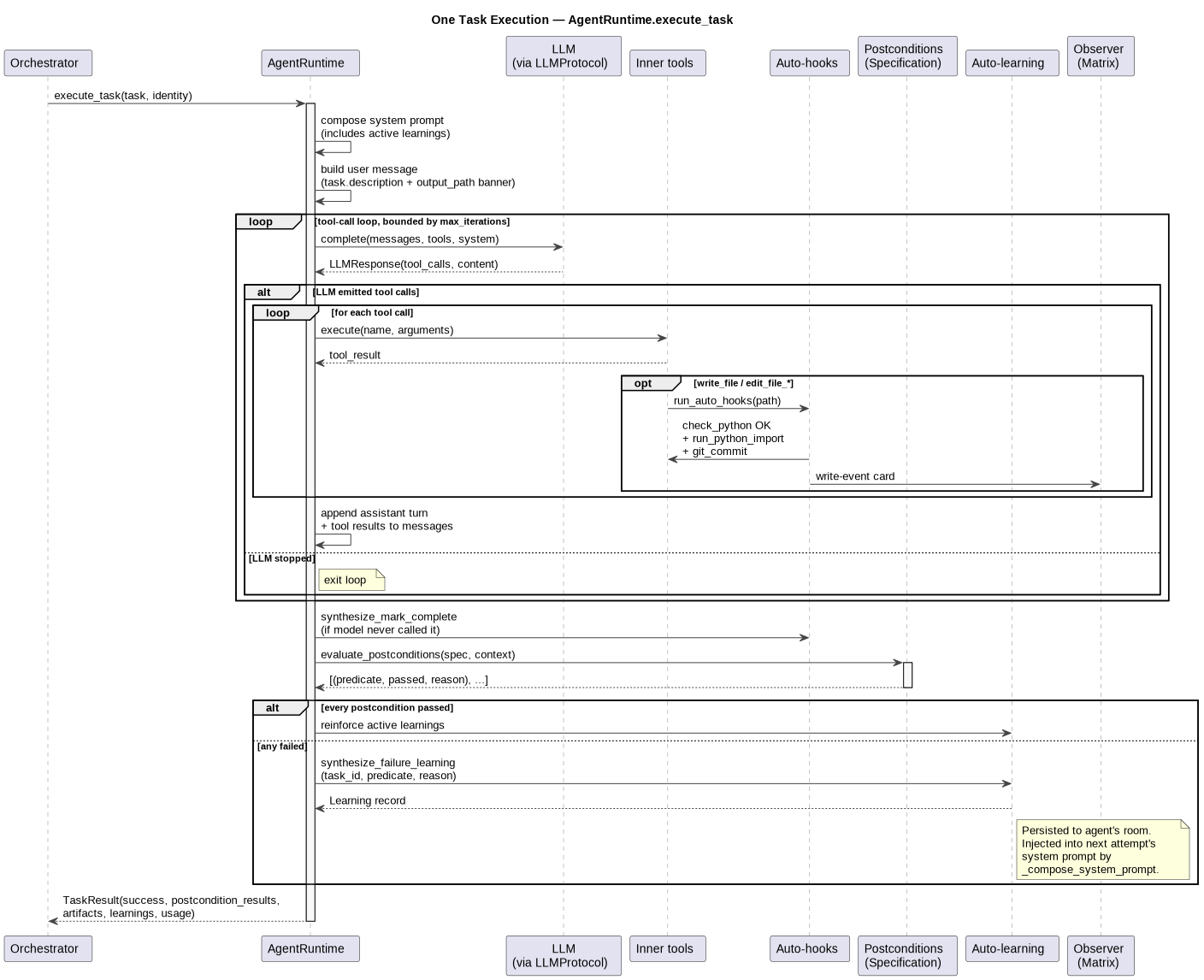
Each of these solved a real failure mode observed in live runs. Remove any one and the framework regresses toward “just a 7B model trying its best”.
1. Postconditions are the ground truth, not the LLM’s self-report
Specification.postconditions is a tuple of Predicates evaluated after each
task runs (core/contract.py:57–72).
A task is success iff every postcondition evaluates True. The LLM’s
mark_complete call is observed but doesn’t determine outcome.
The framework ships four families of postconditions:
Static (cheap, no I/O):
_postcond_file_exists,_postcond_file_contains,_postcond_mark_complete,_postcond_py_compiles.Subprocess (verify running-ness):
postcond_python_imports,postcond_pytest_passes,postcond_requirements_parse(all in fleet/runtime_postconditions.py).AST-level (structural invariants):
postcond_no_code_after_main_blockcatches handlers placed afterif __name__ == '__main__':(unreachable at runtime).Cross-file consistency:
postcond_readme_only_references_existing_commands,postcond_bot_calls_tree_sync.
2. Auto-hooks — framework runs the tools the LLM would forget
After any write_file, fetch_url(save_as=...), or edit_file_* call,
run_auto_hooks (fleet/auto_hooks.py) fires:
.pyfiles →check_python→ (if clean)run_python_importrequirements.txt→check_requirementssuccessful validation →
git_commitwith message"auto: wrote <path>"silently: validation errors appended to the LLM’s next-turn message history so the model sees them without having to remember to call the check tool
silently: write-event card posted to the project room so the observer watches the build in real time
When auto_hooks_enabled=True on ToolContext, the tools check_python,
git_commit, git_diff, git_log, mark_complete, and report_learning are
hidden from the LLM’s tool manifest. The model goes from 14 tools to 7.
3. The flywheel: auto-learnings feed the loopback
When a task fails a postcondition, the orchestrator synthesizes a Learning
from the exact (task_id, predicate_name, reason) tuple
(fleet/auto_learning.py) and injects it
into the agent’s learned_patterns list. The next time _compose_system_prompt
runs for that agent, the learning appears in a ## Learned context block in
the system prompt. Dedup is by stable hash of the normalised reason — same
failure twice doesn’t duplicate, it reinforces.
This replaced the prior report_learning agent-tool path which required the
LLM to self-reflect and often went unused (weak models bail before calling
it).
4. Edit primitives — the model never re-emits existing content
Three tools in fleet/inner_tools.py:
edit_file_replace(path, old_string, new_string)— substitution with unique-match requirement (like Claude Code’s Edit tool).edit_file_insert_before(path, anchor, snippet)— line-anchor insertion.edit_file_append(path, snippet)— append to end.
Replaced the “model re-emits the whole file via write_file” pattern that
consistently introduced transcription errors (discord.InterACTION in
Run 11, duplicated import random). Run 12 onwards never had a
transcription bug on bot.py.
5. Staged tasks + literal templates
For hard-to-generate tasks, the runner splits a Task into a sequence of
Stage objects with small max_iterations caps and pre-loaded context_files
in the user message (fleet/stage_runner.py).
Each stage gets a fresh message history so accumulated context doesn’t blow
past num_ctx. Hard cases (write_requirements, build_skeleton) use literal
code templates — “write EXACTLY this content” — leaving no room for
hallucination.
Round-by-round evolution
Numbers are concrete: Runs N/M = “passed N tasks out of M in that run’s
first attempt”. Loopback retries sometimes bump the final count.
Round |
Problem observed |
Fix added |
Result |
|---|---|---|---|
Pre-1 |
Baseline 7-sprint framework |
(initial) |
Runs but fragile |
1 |
Tasks FAIL silently, mark_complete misses |
Four static postconditions + |
Run 1 · 6/11 via user approve |
2 |
|
Unified work_dir + git; AST undefined-name check; DAG reshape so failures don’t block documentation tasks |
Run 2 · 9/12 |
3 |
syntactic-valid-but-AttributeError bugs slip past py_compile |
Subprocess |
Run 3 · 9/12 FAILED (cascading fetch issue) |
4 |
Regressed because tools encouraged over-engineering |
Hide runtime tools from the LLM, postcondition-only; revert prompts |
Stable but fetch still fragile |
5 |
67 KB |
|
Run 9 · 10/12 approved |
6 |
Model writes to wrong path (kb/design instead of design/modules.md) |
|
Run 10 · 10/12 |
7 |
|
Hierarchical map-reduce distiller on reads exceeding 8 KB threshold |
Run 11 · 9/12 (regression in build_roll edit) |
8 |
Re-emitting 25 lines of bot.py introduces |
Three edit primitives (replace/insert_before/append) |
Run 12 · 12/12 via 1 loopback |
9 |
Review poll is a black box — no file tree, no diff |
Artifact snapshot in review summary; write-event cards; per-task |
Run 13 · 12/12 zero loopbacks (5.3 min) |
10 |
No way to vote except type /agora — slow UX |
Matrix |
Run 13 ran cleanly with new surfaces |
11 |
Handler landed after |
|
Catches exactly the Run-13 bug |
12 |
Stress test in new domain (FastAPI) exposes |
try/except on |
Run 15 · 10/13 approved |
13 |
Model narrates “Let’s read app.py…” instead of calling tool |
|
Run 16 · 13/13 via 1 loopback, pytest passes on produced code |
Empirical evidence — the Run log
Two distinct projects built by the same framework on the same 7B model:
Run |
Project |
First-pass green |
Loopbacks |
Outcome |
Duration |
Tokens |
|---|---|---|---|---|---|---|
1 |
discord-bot |
6/11 |
0 |
DONE (user approved) |
— |
— |
2 |
discord-bot |
9/12 |
0 |
DONE |
— |
— |
3 |
discord-bot |
9/12 |
1 |
FAILED (cascade) |
— |
— |
4 |
discord-bot |
7/12 |
1 |
FAILED (loopback exhaust) |
— |
— |
5 |
discord-bot |
9/12 |
1 |
FAILED |
— |
— |
6 |
discord-bot (qwen2.5-coder:7b) |
0/12 |
0 |
Aborted — coder doesn’t tool-call |
— |
— |
7 |
discord-bot |
7/12 |
2 |
FAILED |
— |
— |
8 |
discord-bot |
8/12 |
0 |
Stopped early |
— |
— |
9 |
discord-bot |
9/12 |
2 |
FAILED |
— |
— |
10 |
discord-bot |
10/12 |
1 |
Stopped on confusion |
— |
— |
11 |
discord-bot |
9/12 |
2 |
FAILED (transcription bug) |
938 s |
300k / 16k |
12 |
discord-bot |
12/12 |
1 |
DONE |
458 s |
54k / 3k |
13 |
discord-bot |
12/12 |
0 |
DONE |
316 s |
47k / 2.4k |
14 |
fastapi-crud |
9/13 |
2 |
FAILED (git_commit bug) |
548 s |
45k / 2k |
15 |
fastapi-crud |
10/13 |
2 |
DONE (approved with failures) |
397 s |
77k / 3.7k |
16 |
fastapi-crud |
13/13 |
1 |
DONE, pytest passes |
359 s |
57k / 3.7k |
17 |
discord-bot-full |
23/23 |
0 |
DONE, pytest 4/4, approved |
600 s |
80k / 3.9k |
Run 13 (Discord bot, 12/12 zero loopbacks, 5.3 min) and Run 16 (FastAPI CRUD,
13/13 one loopback, 6 min) are the reference runs. Both produce functional
code: workspace/discord-bot.run13/bot.py registers all three slash commands;
workspace/fastapi-crud/app.py passes its own pytest suite with 2/2 tests
green.
Run 17 (2026-04-18, discord-bot-full, 23/23, 0 loopbacks, 10 min) is the
scale-up reference: multi-module (config.py + matrix_bridge.py + bot.py + two
test files), eight slash commands that bridge to Agora’s /agora command
surface via matrix-nio, and every task passed on its first attempt. 4/4 pytest
green on the shipped code. Produced on the same qwen2.5:7b hardware that
previously hit the capability ceiling on the small runners — the difference
came from (a) the in-phase auto-retry added in the same session, which meant
the framework could absorb two transient flakes that would have needed
cross-phase loopbacks before, and (b) staging every Python-producing task
with a literal template (run 2 of this runner failed on design_bridge_spec
after it read a 64 KB docs page and returned empty; staging the markdown body
removed the read entirely). Net takeaway: the 7B capability story improves
dramatically when every source-producing task is a template-driven stage.
The 7B capability ceiling — honest assessment
Every failure mode observed in Runs 1–16 falls into one of three categories:
The framework lacked a gate (Run 1–5, Run 11, Run 14). Addressed.
The model hallucinates a fact (
discord.utils.random,commands.Intents,discord.InterACTION,@app.putbeforeapp = ...). Gates catch the failure; auto-learning records it; loopback retries. Works usually. Not always — the model may reproduce the same hallucination on retry (seen repeatedly withimport discordin requirements.txt).The model narrates instead of acting (Run 15, Run 16 first pass). Addressed by
_maybe_queue_narration_redirect— detected + system-authored STOP directive on retry.
What the framework cannot do with a 7B model:
Guarantee zero transcription bugs on edits. Templates + edit primitives reduce the surface but a capability-limited model will still occasionally write duplicate imports or stray decorator stacks.
Absorb abstract corrective advice. “Don’t put
import discordin requirements.txt” appears verbatim in the model’s system prompt across multiple retries and the model still reproduces the bug. The auto-learnings inject the traceback but don’t guarantee behaviour change.
The file-level evidence is clear: the code that ships is structurally
correct even when cosmetically messy. Run 16’s app.py has duplicate dead
function defs, but the decorated versions below them override and the tests
pass.
A 14B+ model plugged into this framework would almost certainly clear
category 2 and 3 entirely. That’s the next-hardware direction (waiting for
~24 GB VRAM per project_paused_for_hardware.md in the memory notes).
File layout — where to look
Runner scripts (drive projects, not framework code):
scripts/run_discord_bot_test.py — 13-task DAG, 7 staged, Discord bot domain
scripts/run_fastapi_crud_test.py — 13-task DAG, 7 staged, FastAPI CRUD domain
scripts/run_discord_bot_full_test.py — stress-test runner: 23-task DAG, 15 staged, multi-module Discord bot that mirrors Agora’s full
/agoracommand surface via a matrix-nio bridge. Built after Round 16 when the small runners hit the 7B capability asymptote; waiting on 14B+ hardware before running for real.
Core framework (don’t touch casually):
src/agora/core/task.py — Task dataclass with
output_pathsrc/agora/core/contract.py — Specification, Predicate, evaluate_postconditions
src/agora/core/learning.py — Learning dataclass + decay/reinforce
src/agora/core/project.py — Project + phase state machine
src/agora/core/agent.py — AgentIdentity + effective_instructions with learnings
Fleet (orchestration):
src/agora/fleet/orchestrator.py —
run_project,_run_phase, per-project work_dir + git unification,_maybe_queue_narration_redirectsrc/agora/fleet/agent_runtime.py —
execute_task, shared_run_loop,_emit_write_event_card,_compose_system_promptsrc/agora/fleet/stage_runner.py — micro-stage execution with fresh context per stage
src/agora/fleet/inner_tools.py — every tool schema + factory: read/write/edit/list, fetch_url, check_python, run_pytest, git_*, mark_complete, report_learning. Also
_find_module_scope_undefined_names,_find_code_after_main_block,AUTO_HOOKED_TOOL_NAMES.src/agora/fleet/auto_hooks.py —
run_auto_hooks+synthesize_mark_completesrc/agora/fleet/auto_learning.py —
synthesize_failure_learningsrc/agora/fleet/runtime_postconditions.py — subprocess-backed postcondition factories
src/agora/fleet/distiller.py — hierarchical map-reduce for large files
src/agora/fleet/control.py — OrchestratorControl: notes, redirects, task_comments, task_card_events, task_reactions, handle_command/reaction/reply
src/agora/fleet/web_fetch.py — SSRF-safe fetcher with single-retry on transient errors
src/agora/fleet/_subprocess.py — env-whitelisted subprocess with timeout
src/agora/fleet/vram.py — VRAM pre-flight + model warm-up via Ollama /api/ps and /api/generate
src/agora/fleet/llm_adapter.py — Anthropic + Ollama adapters with the JSON-in-content fallback for non-tool-call models
Observer (Matrix side):
src/agora/observe/formatters.py — every FormattedMessage factory (phase, task, review summary with ArtifactSnapshot, write-event card, command reference)
src/agora/observe/review.py — ReviewCoordinator,
_gather_artifact_snapshot(files + git log + failures + reaction counts),_ANSWER_TO_PHASEwith alias mapsrc/agora/observe/polls.py — MSC3381 poll build/parse
src/agora/observe/commands.py —
/agoraverb parser, includingcommentsrc/agora/observe/renderer.py — renders phase/task events to formatted room messages
src/agora/observe/sync_service.py — Matrix sync loop
src/agora/matrix/sync.py — EventDispatcher with reactions + reply relations
How to relaunch a run (future-me quickstart)
Start Ollama (if not already):
ollama servein a terminal. Checkcurl http://localhost:11434/api/tagsreturns JSON.Start Conduit:
docker-compose up -din theconduit/dir. Ensure theagora.localhomeserver is reachable athttp://localhost:6167.Activate the venv:
.venv/Scripts/python.exeis the interpreter to use (Windows layout;source .venv/bin/activateon POSIX).Archive the previous run:
mv workspace/<project> workspace/<project>.runNso the fresh run starts clean.Run:
.venv/Scripts/python.exe scripts/run_<project>_test.py.Watch Element as
@fabs:agora.localfor phase banners, write-event cards with reaction hints, and the REVIEW poll.Observer commands (type in the project room):
✅,🔁,💬reactions on a task card (informational + reply hint)Reply button → plain text → becomes an implicit task comment
/agora pause·resume·abort/agora note <text>— attach note for all agents/agora comment <task_id> <text>— per-task feedback/agora review approve·reject(==reject_implementation) ·retry·reject_analysis·reject_architecture·reject_testing
Auxiliary memory (session-crossing notes)
The following are kept in <home>\.claude\projects\PROJECT\memory\
and apply to future sessions:
project_paused_for_hardware.md— hardware upgrade (~24 GB VRAM) planned May 2026; switching toqwen2.5:14b-instructorqwen2.5:32bis the next big lever.project_fetch_retry_planned.md— hardened in Round 5 (save_as+ bounded retry).project_model_capability_ceiling.md— qwen2.5:7b reproduces hallucinations even after learnings; framework fine, model is the bottleneck.
Deferred / not done
Not bugs, just intentional deferrals:
Elements of scope creep: build_skeleton stages tend to write extra files (README.md, requirements.txt) beyond their declared
output_path. Soft-warn fires; tests pass anyway. Harmless but noisy. A stricter stage instruction could forbid this.Stub functions shadowing decorated endpoints (Run 16). AST could detect same-name function defs where only one has an
@app.*decorator and warn.Checkpoint + resume:
agora resume <project_room_id>to continue a run after a crash. Scaffolding exists (Matrix timeline is authoritative) but never tested end-to-end.Task hierarchy / sub-tasks: for multi-module projects where a task spawns children at runtime. Flat DAG works up to ~20 tasks; beyond that the renderer would need a tree view.
qwen2.5-coder:7b integration: coder-tuned models emit tool calls as JSON in content. The JSON-in-content fallback parser exists but coder still produced worse results than instruct (Run 6). Not worth more time without a fundamentally different model.
Test infrastructure — how to keep the gate
Full suite:
.venv/Scripts/python.exe -m pytest tests/ --cov=agora --cov-fail-under=80 --timeout=90 -qPer-module smoke tests while developing:
pytest tests/fleet/test_<name>.py -vCoverage gate is 80% globally. Rebuilding it would require rewriting the MCP handler tests (currently 78% covered) or the VRAM module (68%) — both genuinely hard to unit-test without a live GPU.
462 unit/integration tests protect the framework. The e2e tests in
tests/fleet/test_e2e_live.py skip by default; set AGORA_E2E=1 with
Conduit running to exercise them.
Post-2026-04-17 work
The 2026-04-17 snapshot above closes the discord-bot/fastapi-crud
stress-test week with framework stable on qwen2.5:7b. The work below
covers the next nine days: a multi-provider adapter, a third test bed
(URL shortener), the plan-builder meta-flow, and four progressive
hardening rounds whose load-bearing logic now lives in src/agora/plan/.
Test count drift: 501 → ~1090. Coverage gate held; new code carries
its own tests (tests/plan/test_structure.py 71 tests,
tests/fleet/test_llm_adapter_litellm.py 34 tests, etc.).
Multi-provider — LiteLLM adapter
fleet/llm_adapter.py gained
LiteLLMAdapter, a thin shim over litellm.completion() that maps any
provider/model-id (OpenAI, Anthropic, Gemini, Mistral, Together, …)
through a single Agora-shaped LLMAdapter interface. The whitelist of
permitted prefixes lives in LITELLM_PROVIDER_PREFIXES; the harness’s
create_llm_adapter dispatches by prefix. Ollama remains its own adapter
to keep the local-first path honest.
Cost tracking landed in the same change: litellm.completion_cost() is
called per response and aggregated into AgentRuntime.token_usage (now
holding both int token counts and float cost_usd).
fleet/agent_runtime.py’s
_merge_usage was extended to handle the float field; harness.py’s
_print_summary displays per-run cost; preflight_vram skips when the
target is a non-Ollama model.
Empirical effect (URL shortener test bed): gpt-4o-mini ran the
plan-builder for ~$0.025/run and the executor for similar; gpt-4o ran
the executor for ~$0.40 per attempt. Numbers are session-memory estimates
not log-recorded — see runs/registry.yaml cost.source: estimated.
Plan-builder meta-flow
flows/plan-builder.plan.yaml is an 11-task
DAG that builds a v2.0 executor plan from a brief: gather context,
decide library + storage, author api_spec, draft tasks, vote, emit. It
runs through the same run_plan.py machinery as any other plan, so its
postconditions are first-class.
This flow is the one that drove most of the post-2026-04-17 hardening
work — the 14 archived plan-builder runs at
workspace/plan-builder.run*/ are the empirical record. See
runs/registry.yaml for per-run breakdowns and
runs/findings.md for the cross-cutting analysis.
Round-by-round evolution (14–18)
Same shape as the table for Rounds 1–13.
Round |
Problem observed |
Fix added |
Result |
|---|---|---|---|
14 |
gpt-4o-mini gets stuck in |
|
Edit-loop killings stopped; 4o-mini ergonomics close to Claude Code |
15 (C1) |
Plan-builder produces plans whose api_spec doesn’t cover all brief deliverables |
|
Brief-coverage gap caught in |
15 (C4a/C4b) |
Architect emits |
|
Plan-builder.run10 + run11 triggered both fixes |
15 (C5) |
api_spec.md parses but contains duplicate module headers, free-text prose, or markdown bullets that survive |
|
Plan-builder.run9 (bullet) + run13 (test-module) caught at gate; |
16 (Structural L1/L2/L3) |
Field-name typos ( |
New module plan/structure.py (~900 lines): |
Catches contract-test drift and self-inconsistent impls before runtime; opt-in strict mode for high-confidence shipping |
17 (Phase 2) |
Tester writes assertions against the wrong return type (declares |
|
Run-12 of plan-builder validated; tester drift now caught at fill_test_body, not at execute time |
17 (Phase 3) |
Impl class reads from |
|
Field typos caught structurally; gpt-4o run on URL shortener passed this gate cleanly |
18 (Tool lockdown) |
Architect calls |
|
Plan-builder.run10 was the canonical “architect deleted its own output” case; lockdown made it impossible after |
Empirical evidence — extended Run log
Same shape as the original Run table. Full per-run records with extracted task pass/fail and durations live in docs/runs/registry.yaml; this short summary catches the cross-tier comparison highlights:
Run |
Project |
Model |
First-pass green |
Outcome |
Notes |
|---|---|---|---|---|---|
URL-1 |
url-shortener-mvp |
qwen2.5:7b |
2/10 |
62-min stuck-loop |
Capability-ceiling baseline |
URL-2 |
url-shortener-mvp |
gpt-4o-mini |
2/4 |
killed (edit-loop) |
Drove edit-tool ergonomics fix |
URL-3…6 |
url-shortener-mvp |
gpt-4o-mini |
2/4 each |
partial |
C5 / phase-2 progressively wired |
URL-7 |
url-shortener-mvp |
gpt-4o-mini |
2/4 |
partial — value typo |
Framework gates passed; 4o-mini failed value-level test |
URL-live |
url-shortener-mvp |
gpt-4o |
structural gates passed; 4/5 contract tests |
partial |
Tester constructed wrong tuple — model-reasoning-depth gap, not framework gap |
PB-1, PB-2 |
plan-builder |
qwen2.5:7b |
1/4–1/5 |
aborted |
Silent failure + MSC3381 polls bug |
PB-3 |
plan-builder |
qwen2.5:7b |
11/21 |
structurally broken plan |
Pre-Approach-C |
PB-4 |
plan-builder |
qwen2.5:7b |
5/9 |
C-failed |
Confirmed 7B can’t absorb C1 feedback |
PB-5…13 |
plan-builder |
gpt-4o-mini |
5/9–11/21 |
various structural defects, framework hardened in response |
Each defect drove a specific gate (C5, auto-strip, C4a/b, edit-loop fix, …) |
PB-14 |
plan-builder |
gpt-4o-mini |
11/21 |
REFERENCE PLAN-BUILDER GREEN RUN |
All gates active, plan came out clean, ~$0.025 |
CR-1, CR-2 |
code-review |
qwen2.5:7b |
0/5 each |
aborted |
Reviewer agent under 7B doesn’t produce usable reviews — defaults to “looks clean” on every file |
What the framework cannot do (extended)
The 7B-only “cannot” list from the original snapshot still applies. The multi-provider runs added two more cases:
Catch value-level errors that aren’t structural. gpt-4o on the URL shortener passed every framework gate and 4/5 tests; the failing test failed because the tester constructed the wrong tuple shape — a value-level reasoning bug the framework cannot see without running the tests, and that the model under test cannot see in itself. This is the practical ceiling for a sub-Sonnet model on this DAG.
Replace model judgment in code review. The code-review flow runs cleanly on 7B and produces structured output, but the actual review content is “looks clean” regardless of whether the file is clean. The reviewer agent under 7B has effectively zero analysis capability for this task. The framework can’t synthesize judgment that isn’t there.
Cross-tier hierarchy — observed
Tier |
Effective working memory |
Agentic recommended |
$/run on URL-shortener exec |
|---|---|---|---|
qwen2.5:7b |
~4k |
no |
$0 (local) — but capability-bound |
qwen2.5:14b (untested) |
~8k extrap. |
maybe |
$0 — pending hardware |
gpt-4o-mini |
~8k |
yes |
~$0.025 estimated |
gpt-4o |
~16k |
yes |
~$0.40 estimated |
claude-sonnet-4-6 (untested) |
~24k extrap. |
yes |
n/a |
claude-opus-4-7 (untested) |
~40k+ extrap. |
yes |
subscription |
The same DAG runs on each tier; the DELTA across tiers is what runs/
documents. Lower tiers benefit from the framework — every gate caught a
bug the model would otherwise have shipped. Higher tiers may benefit
less: an agent with 24k+ effective working memory can hold the whole
brief plus the contract plus its own draft in context, so postcondition
gates feel more like ceremony than scaffolding. This is an open question
not a finding — see runs/findings.md Section 6.
Operating principles (held throughout)
These are the rules that emerged from the run history and held across all 18 rounds:
Resist adding postconditions speculatively. Every postcondition added in Rounds 1–11 was driven by a failure observed in a real run. If a new failure shape hasn’t shown up, don’t pre-emptively guard against it — friction without evidence of value.
The framework is at the asymptote for 7B. Diminishing returns on more framework work against this model. The real leverage is upgrading to 14B+ class. Before spending another round on 7B-specific scaffolding, ask: would this same capability just work at 14B?
Don’t regress the test count or coverage gate. Test count was ~501 at 82% in the original snapshot; ~1095 at 80%+ post-2026-04-17. A refactor that drops below the gate is a refactor that destroyed evidence.
Confirm the framework still delivers before extending it.
python scripts/run_discord_bot_test.pyshould hit DONE 12/12 in ~6 minutes onqwen2.5:7b-instruct. If it regresses after a change, that change broke an invariant.